Veteran Airstream owners say most winter camping gear is overkill for a light freeze. Here’s how to know exactly what your trip actually demands.
By Tim Ryan, GenX Glamping Guy | February 2026
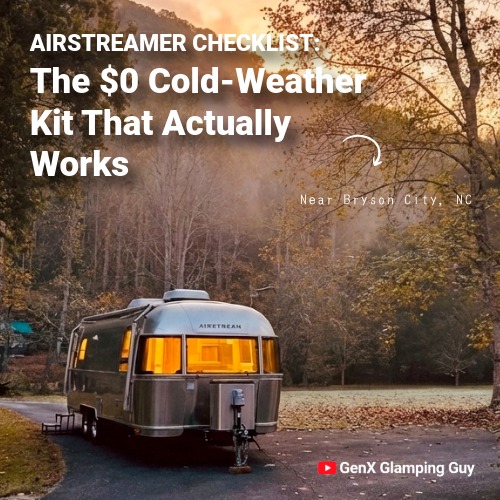
I left Louisiana in December with the humid temps still sitting in the 80s. By the time me and my Airstream made it to Athens, GA, the weather was perfect. That’s where I met my mom and her husband to show them how to setup and tear down their new RV. After a few days together in Athens, I decided to spend another week working remotely. I headed outside of Bryson City, North Carolina. Climbing into the Appalachian Mountains with my 2022 Airstream 27′ Globetrotter in tow, the thermometer nosedived toward freezing. I’ll be honest, I wasn’t sure I had what I needed to keep me and the Airstream warm. Would I need heated hoses? What about a tank heater or thermal skirting? I was half-convinced I’d burst a pipe or have frozen propane tanks.
Free Download: Airstream Cold-Weather Camping Quick-Reference Guide
Rather than panicking, I leaned on the people who know all about camping in freezing temperatures. I combed Airstream owner groups on Facebook and threads on Reddit. This is where I learned from experienced campers how they really prep for overnight freezes. The advice stopped me mid-checkout on three separate gear websites. In reality, for a light freeze lasting only a few hours, you probably already have everything you need. The key word, though, is light. That framing only holds for a specific set of conditions. Knowing exactly where that line is will save your pipes, your propane budget, and your sanity.
Know What’s Actually at Risk
Before you spend a dollar on cold weather Airstream camping gear, understand what’s at risk. Your city water hose is the first and most fragile failure point. It will freeze well before your internal tanks do. Water left sitting in your sewer line is a close second. Your outdoor shower valve, if not drained, holds water and can crack. And your propane regulator can struggle in the cold if you’re only running one tank valve open. Even your water pump can get hairline cracks, causing leaks (although, the Airstream water pump is easy to replace).
One thing I discovered after a sleepless night: there’s a water heater safety mechanism designed to prevent the coils from freezing and splitting open. If you go to bed without the furnace on, this mechanism cycles every hour. It beeps too if you have not activated your propane. It will throw an E1 error code on the display. The beeping is enough to drive you batty at 2 a.m. I speak from experience.
Understanding Your Airstream’s Two Heating Options
My 27′ Globetrotter has two heating zones. Zone 1 is for the sleeping quarters. Zone 2 is for the rest of the trailer. There are also two distinct heating options. Knowing which to use and when is the real foundation of cold-weather readiness.
▶️ Video: How to Keep Your Airstream Warm in Freezing Temps: Heat Pump vs. Furnace
Heating Option 1: The Heat Pump (Above 40°F)
When temps stay above 40°F, the heat pump is your first call. It runs through the air conditioning unit, so shore power is your best bet. It’s effective for taking the nip out of the air and, in my Globetrotter, blows in zones one and two. Fair Warning: it’s loud. On more than one night I’ve swapped the heat pump with a small space heater and extra blankets.
Heating Option 2: The Furnace (Below 40°F)
When temps dip below 40°F, the furnace takes over. Unlike the heat pump, it runs on propane plus battery power for the blower fan, making it the go-to for boondocking. In my Globetrotter, the furnace only runs in Zone 2. The good news is that the furnace doesn’t just heat the interior: it pushes warm air through floor vents and also warms the underbelly, protecting your plumbing. On genuinely freezing nights, I open the cabinet doors under the sink to help keep the water pipes warm. One important heads-up from the community: if you run a space heater at night, position it away from the thermostat. A space heater placed too close can artificially raise the sensed temperature and prevent the furnace from cycling on when it needs to.
Set your thermostat fan to AUTO for the most efficient operation. The fan only runs when the system is actively heating, saving energy.
“If the freezing temps are only for a few hours at night, your furnace will keep the tanks warm enough.” — Airstream owner community, on overnight light freezes
The Three-Tier Framework: Match Your Kit to Your Conditions
Tier 1 — The Light Freeze (Below 32°F for a Few Hours)
This is the scenario I was prepping for with my Globetrotter, and what the Airstream community confirms requires the least gear. Four essentials do the heavy lifting, and none of them cost extra if you already own the rig.
Run your furnace overnight. It heats the interior and warms the underbelly. Top off propane before temps drop and open both tank valves so the regulator can auto-switch when one gets too cold to flow. Fill your fresh water tank and disconnect the city hose before bed. The hose freezes first, every time. Run off your internal water overnight; the furnace keeps those tanks warm. Drain your sewer line and only dump when necessary. Never leave water sitting in the hose overnight.
“For short stays, we fill up our freshwater tank. That’s more thermal mass for your propane furnace to warm up and it will stay warmer longer than am empty tank!” – Airstream owner community, on overnight light freezes
That’s genuinely it for a light freeze.
Free Download: Airstream Cold-Weather Camping Quick-Reference Guide
Tier 2 — Sustained Cold (Multi-Day or Temps Below 20°F)
Here the calculus genuinely shifts. Thermal skirting makes a meaningful difference in wind, cutting heat loss from the underbelly significantly. Tank heaters provide real backup when the furnace has been running hard for multiple days. A space heater reduces propane consumption and adds redundancy. An RV dehumidifier prevents the “raining inside” condensation effect that hits on multi-night cold stays. Cracking a vent helps too. And bring extra propane; consumption climbs fast when temperatures stay down for days at a stretch.
One smart and inexpensive addition: carry a spare furnace sail switch. It’s a small metal strip that activates the furnace based on airflow through the ductwork. It’s a known cold-weather failure point. If your furnace cycles several times without lighting, the sail switch is the first thing to check. Dust, debris, and even cat hair can build up on it over time. Carry a spare and clean it regularly.

If your thermostat offers a HEAT PUMP + FURNACE mode, use it. In this mode, the heat pump runs first to conserve LPG. The furnace kicks in automatically under these conditions:
- If the interior temperature drifts more than 3 degrees from the outpoint
- If outdoor temps drop below 25°F
- If the heat pump begins to defrost.
Check your owner’s manual — this mode isn’t available on all model years.
Tier 3 — Extreme or Remote Winter Camping
Sub-zero temps, high elevation, dispersed camping with no bailout option takes us into a the major league of Airstream glamping. Full winterization, redundant heating systems, and an honest assessment of your specific rig’s capabilities are non-negotiable here. Not all Airstreams are equal: a 2022 Globetrotter and a 1985 Sovereign handle sustained cold very differently. Know your model year’s insulation and underbelly protection before assuming any tier applies cleanly to your rig.
The Optional Gear — Honest Verdicts
A heated water hose is Tier 3 only. Meaning, it’s unnecessary if you disconnect and use your fresh water tank. Tank heaters belong at Tier 2 and above; overkill for a single overnight dip. Thermal skirting earns its place at Tier 2 and above, especially in windy conditions. A space heater is useful at any tier for propane savings and redundancy. A dehumidifier is great for multi-night stays. And a heavy blanket or curtain hung inside the door? Laughably low-tech, community-tested, and surprisingly effective at any tier.
💰 What It Actually Costs
Tier 1 light-freeze essentials vs. buying everything the cold-weather RV industry recommends.
| Item | Tier 1 (Light Freeze) | Full Industry Kit |
| Heated water hose | $0 — disconnect instead | $80–$150 |
| Tank heaters | $0 — furnace handles it | $60–$120 |
| Thermal skirting | $0 — not needed | $300–$2000 |
| Antifreeze kit | $0 — not needed | $20–$40 |
| Spare furnace sail switch | $8–$15 | $8–$15 |
| Space heater (optional) | $30–$60 | $30–$60 |
| Dehumidifier | $0 — not needed for warmth | $40–$250 |
| Total | $8 – $75 | $558 – $2635 |
Free Download: Airstream Cold-Weather Camping Quick-Reference Guide
The Bottom Line
For a light freeze in a well-maintained modern rig, the four essentials — furnace, propane, fresh tank, drained hose — are genuinely sufficient. But know your conditions, know your rig, and scale up deliberately when the situation calls for it. Cold-weather glamping is accessible when you error on the side of caution.
Glamp on.
❓ Frequently Asked Questions
Researched from Airstream owner communities on Facebook and Reddit, plus Airstream owner manuals. — Tim Ryan
Q: What are the absolute must-haves for Airstream camping in overnight freezing temps?
The community is consistent: your furnace, full propane tanks with both valves open, a filled fresh water tank with city hose disconnected, and a fully drained sewer line. Everything else is optional for a light freeze.
Q: What if the RV furnace comes on several times but doesn’t light?
Check the sail switch first. It’s a thin metal strip that activates the furnace based on airflow through the ductwork. If there’s a blockage or the fan isn’t working properly, the sail switch won’t activate — preventing ignition. Dust, cat hair, lint, and debris can build up on it over time. Clean it regularly and carry a spare.
Q: On a 27′ Airstream Globetrotter FBQ, Zone 1 stays electric. Can I switch it to propane?
Typically, no. The electric heat pump operates for both Zone 1 and Zone 2. The gas furnace focuses on Zone 2 only, delivering warmth at floor level while also warming the belly pans and pipes. Zone 1 is electric-only on most Globetrotter configurations.
Q: Which fan setting should I use for the heat pump?
According to Airstream, always set the fan to AUTO. This means the fan only runs when the system is actively heating or cooling, saving energy and battery.
Q: If the heat pump stops working below 40°F, will the furnace come on automatically?
It depends on your model. On the 2024 Flying Cloud, selecting HEAT PUMP + FURNACE mode on the thermostat enables automatic furnace backup if interior temp drops more than 4 degrees. This option was not present in the 2022 Globetrotter manual — check your specific owner’s manual.
Q: When both heat pump and furnace are selected, how does the system decide which to use?
The heat pump runs first to conserve LPG. The furnace kicks on if the interior drifts more than 3 degrees from the setpoint, if outdoor temps drop below 25°F, or if the heat pump begins to defrost.
Q: Can a space heater prevent the furnace from running?
Yes. A space heater positioned near the thermostat can artificially raise the sensed temperature and prevent the furnace from cycling on. Position it thoughtfully — away from the thermostat.
Q: What power does the Airstream furnace require?
Propane for heat plus battery power for the blower fan. The fan’s draw is low — making the RV furnace a solid option for off-grid cold-weather camping.
Q: When boondocking in freezing temps, will batteries last all night with the furnace running?
Most Airstream owners report making it through the night at or near 100% charge. Tip: lower your refrigerator setting before bed to reduce its overnight run time and conserve battery.
Q: Can you run the furnace in one zone and heat pump in another simultaneously?
It depends on your thermostat mode settings. Check your owner’s manual or the mode options on your specific thermostat to confirm what’s available on your model year.
Q: What’s the best way to keep the Airstream bedroom warmer when the furnace only runs in Zone 2?
A small space heater in Zone 1 works well. I have a Vornado, but a similar compact unit is plenty. Electric blankets or heated mattress pads are also community favorites for the sleeping quarters.
Q: How does the RV heat pump compare to the furnace for warming the space?
The heat pump is essentially a reverse AC unit — noisy, pushes warm air from the ceiling, and becomes noticeably less effective as exterior temps drop below 40°F. Most owners rely on the furnace once it gets genuinely cold.
Q: Do I need antifreeze, heated hoses, or tank heaters for a single overnight freeze?
Not usually. If temps dip below freezing for only a few hours and your furnace is running, your tanks will stay warm enough. Save those investments for Tier 2 and Tier 3 conditions.
Tim Ryan is a Louisiana-based Airstream owner, glamping advocate, and YouTube creator dedicated to making comfortable outdoor travel accessible. Through his 2022 Airstream 27′ Globetrotter, he documents real-world trips, gear reviews, and practical how-tos — blending humor with hard-won road wisdom. He has seen Bigfoot 🕺 twice. He has the fastest-growing YouTube channel about GenX Glamping and is a top 10 Airstream outdoor influencer (100% self-reported). Glamp on!
You May Also Like:
The Airstreamer’s Guide to Campground Setup and Tear Down
Airstream Field Test: Best Walkie Talkies for RVs and Camping
Side-By-Side Comparison: A Search for a Better Airstream Step
Leave a Reply